Transforaminal Lumbar Interbody Fusion (TLIF)
A lumbar fusion approach designed to address selected causes of nerve compression and spinal instability.
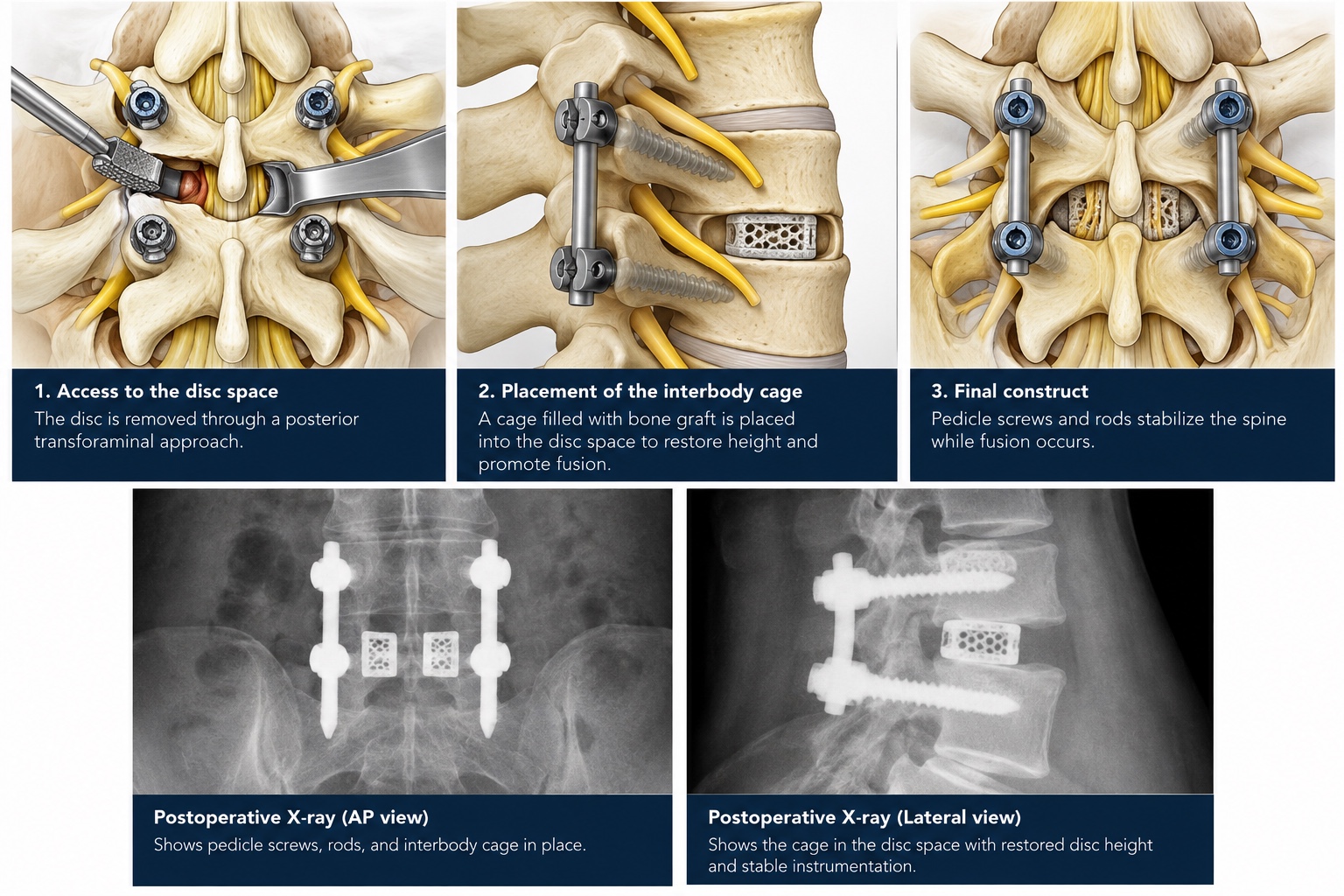
What is TLIF?
In TLIF, the lumbar disc space is accessed from a posterior-side approach. The surgeon may decompress affected nerves, remove disc material, place an interbody spacer with bone graft, and use pedicle screws and rods to stabilize the segment as fusion develops.
When might it be considered?
TLIF may be considered for selected cases of spondylolisthesis, instability, recurrent disc pathology, stenosis with instability, or degenerative conditions when fusion is appropriate. Not every patient with back or leg pain needs fusion.
Open and minimally invasive approaches
The approach depends on anatomy, number of levels, prior surgery, deformity, and surgical goals. Minimally invasive approaches can reduce some soft-tissue disruption, but are not suitable for every situation.
Recovery and risks
Recovery varies, and solid fusion generally takes months. Potential complications include infection, blood loss, dural tear, nerve injury, nonunion, implant-related problems, and adjacent-segment disease.