Minimally Invasive Spine Surgery
A personalized approach that prioritizes the least disruptive treatment capable of addressing the problem durably.
Less Disruption. Lasting Goals.
Dr. White's approach to spine surgery starts with a question: What is the least disruptive treatment that can reliably address the problem and help this patient return to the activities they love? Sometimes that means a focused, minimally invasive operation. Other times, a more extensive procedure—or continued nonsurgical care—may be the better choice.
METRx Tubular Retractors and Surgical Microscopy
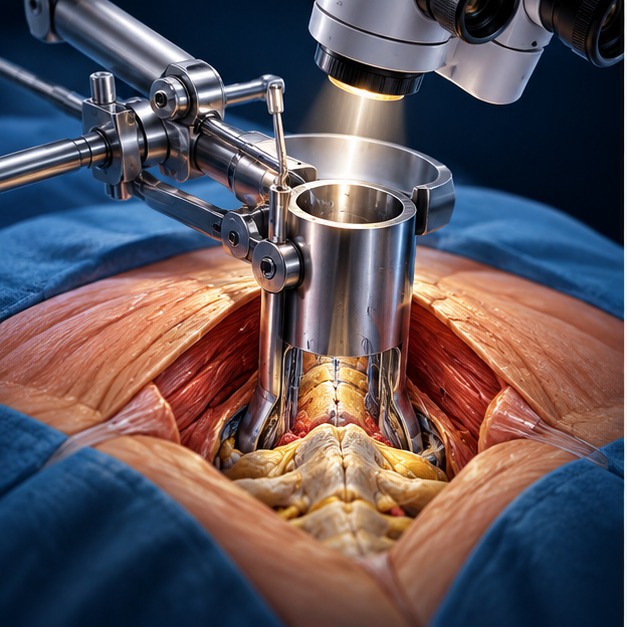
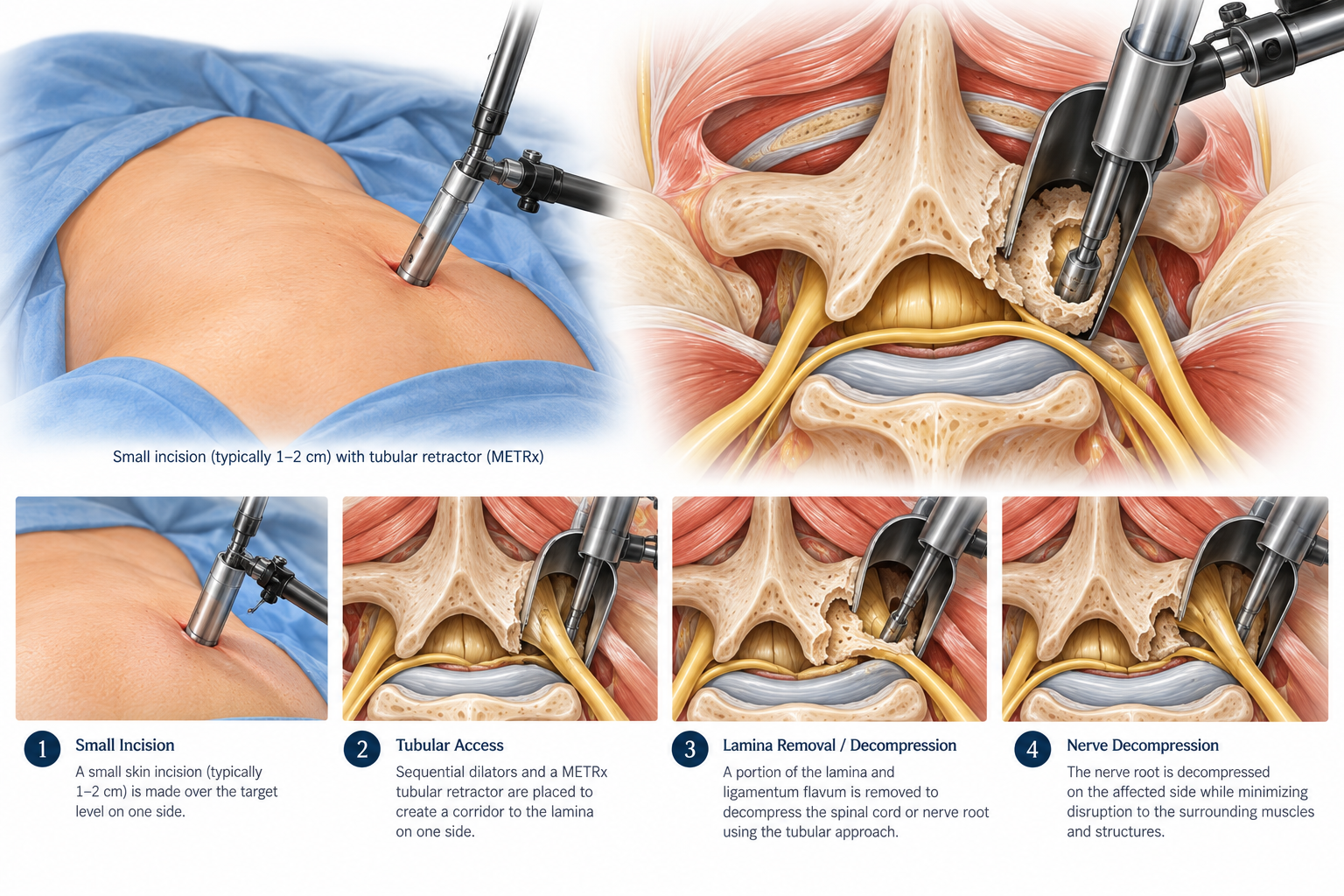
For appropriately selected procedures, METRx tubular retractors create a narrow working corridor to the spine. Sequential dilators gently separate the surrounding muscle, and an operating microscope provides magnification and illumination to help the surgeon visualize delicate structures.
Minimally Invasive Lumbar Laminectomy
A unilateral tubular approach provides focused access to the lamina for selected lumbar decompressions. The illustration below shows a smaller tubular retractor positioned on one side of the lamina.
Potential Applications
Microscope-assisted tubular approaches may be considered for selected lumbar disc herniations and nerve decompression for spinal stenosis. The choice depends on the patient's symptoms, imaging, anatomy, spinal stability, and prior surgery.
Why the Smallest Incision Isn't Always the Best Operation
Minimally invasive approaches may reduce soft-tissue disruption for certain patients, but incision size is only one part of the decision. Complete and safe treatment of the underlying condition, preservation of function, and a durable result are the priorities. Some conditions require a broader exposure or stabilization.
A Strategy Built Around Your Life
Whether the goal is getting back to tennis, hockey, work, walking, or everyday family activities, Dr. White works with patients to weigh nonsurgical options, the expected benefits and risks of surgery, and the recovery demands of each approach. The objective is a thoughtful plan for a safe return to meaningful activity—not a one-size-fits-all operation.
Recovery and Risks
Recovery varies with the diagnosis and procedure. Risks can include infection, bleeding, dural tear, nerve injury, persistent or recurrent symptoms, and the possibility that a larger operation may be required. Individual outcomes and timelines cannot be guaranteed.