Posterior Cervical Laminectomy & Fusion
Decompression of the cervical spinal cord with stabilization when appropriate.
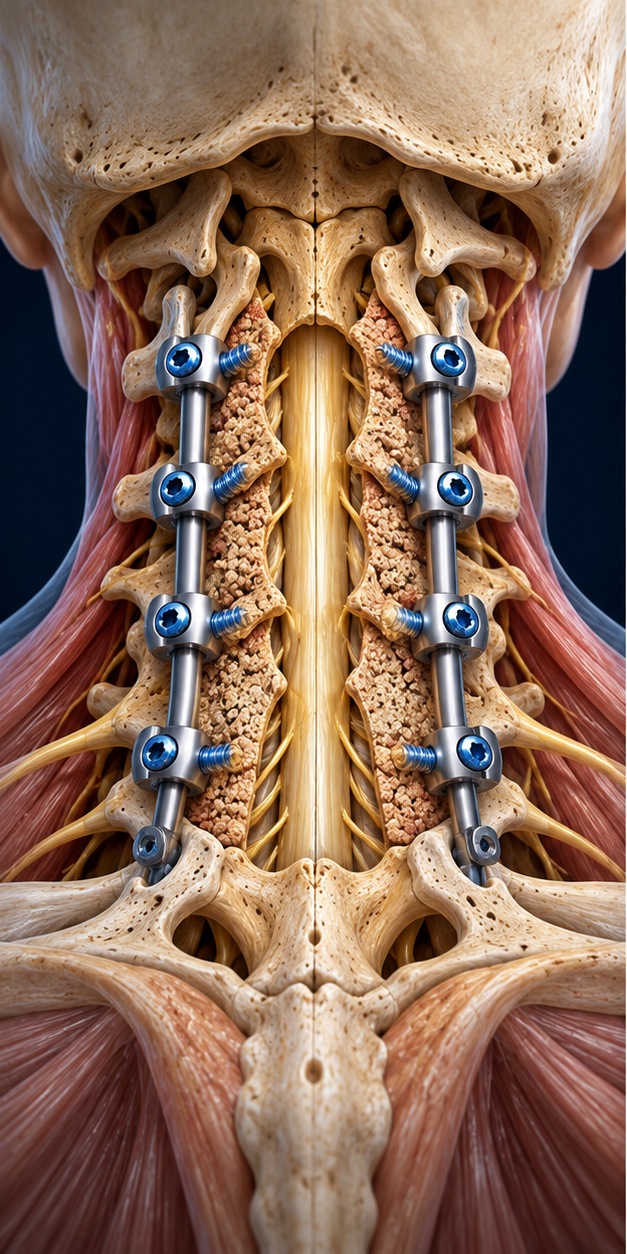
What is posterior cervical laminectomy and fusion?
Through an incision at the back of the neck, the surgeon removes selected portions of the lamina and other compressive tissue to enlarge the space available for the spinal cord. When stability and alignment require support, screws and rods may be placed and bone graft added to encourage fusion.
When is it considered?
It may be an option for multilevel cervical spinal stenosis and cervical myelopathy, particularly when the spinal alignment and pattern of compression favor a posterior approach. Symptoms can include loss of hand dexterity, imbalance, weakness, or altered sensation. The best approach depends on examination and imaging.
What does fusion add?
Fusion stabilizes the treated levels but reduces motion at those segments. Instrumentation may use lateral mass screws, pedicle screws, or other fixation selected for the anatomy. The number of levels is individualized.
Recovery and important risks
Recovery depends on the extent of decompression and fusion, general health, and neurological function before surgery. Risks include infection, bleeding, wound problems, dural tear, spinal cord or nerve injury, postoperative C5 palsy, nonunion, hardware problems, adjacent-level degeneration, and persistent symptoms. Surgery may aim to prevent neurological deterioration; reversal of longstanding spinal cord deficits is not guaranteed.