Cervical Disc Replacement
A motion-preserving alternative to cervical fusion for appropriately selected patients.
What Is Cervical Disc Replacement?
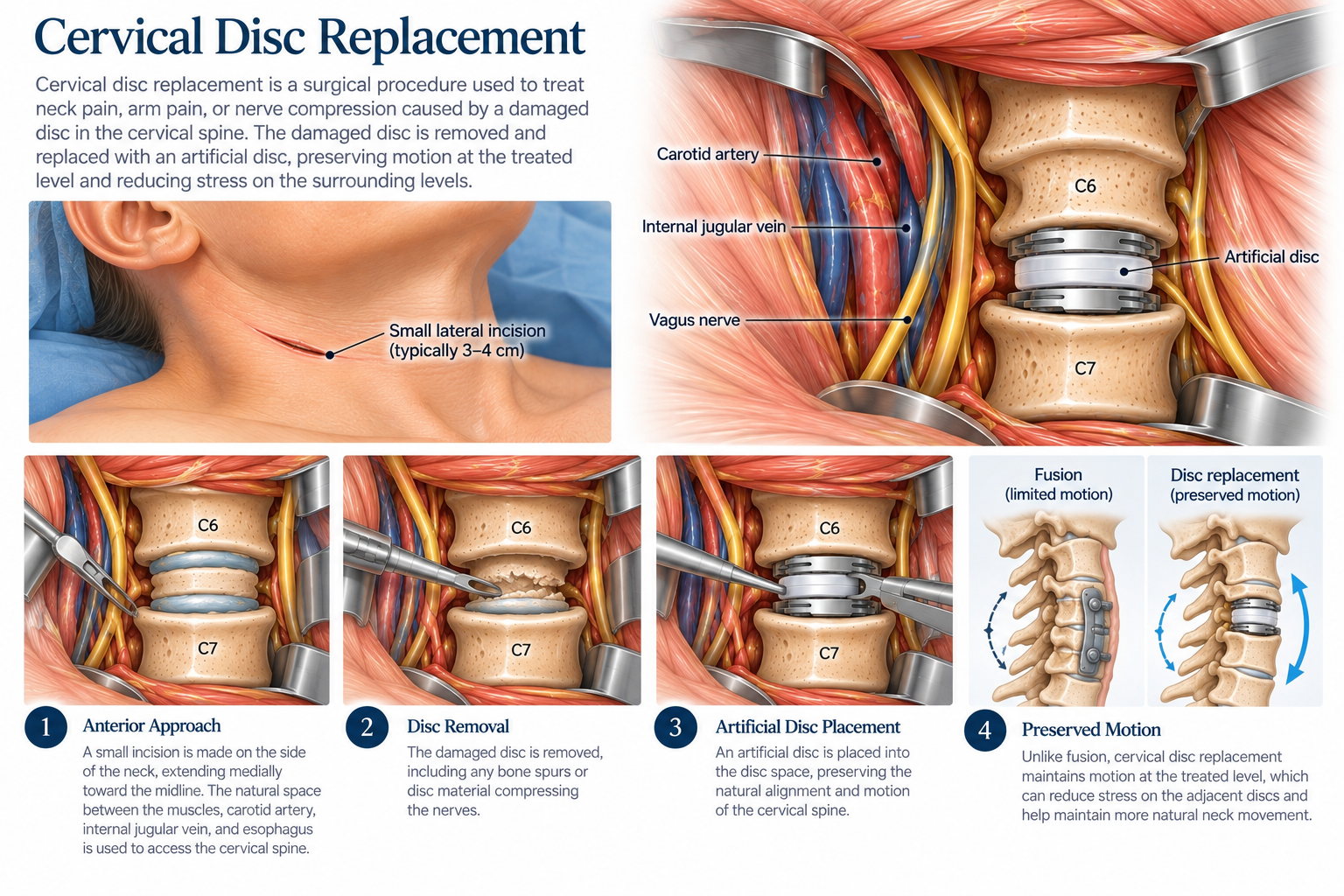
Cervical disc replacement, also called cervical arthroplasty, removes a damaged disc and replaces it with an artificial disc designed to maintain motion at the treated level. Unlike anterior cervical discectomy and fusion (ACDF), the goal is to preserve movement between the vertebrae.
A Small Anterior Neck Approach
The procedure is performed through an incision along a natural crease at the front of the neck. The surgeon accesses the disc space, removes the damaged disc and compressive material as indicated, and places an appropriately sized artificial disc. The incision varies with anatomy and surgical needs.
Who May Be a Candidate?
Selected patients with one or two symptomatic cervical disc levels causing nerve-root or spinal-cord compression may be considered after examination, imaging, and review of nonsurgical options. Significant facet arthritis, instability, deformity, or osteoporosis may make fusion or another treatment more appropriate.
Disc Replacement Compared with ACDF
Both procedures aim to relieve compression. ACDF stabilizes the treated segment by fusing the vertebrae, while disc replacement aims to retain segmental motion. Motion preservation does not guarantee prevention of adjacent-level degeneration, and not everyone is a candidate.
Recovery, Risks, and Expectations
Recovery and return to activity depend on the patient and procedure. Potential complications include swallowing difficulty, voice changes, infection, bleeding, nerve or spinal cord injury, implant migration or wear, abnormal bone formation, persistent symptoms, and possible revision surgery. No specific result or recovery time can be guaranteed.